
Brookline City Directory Holdings
The Brookline Room holds an intermittent local run rather than a yearly, uninterrupted set. Its local-history collection identifies city directories for 1875-1889, 1891-1920, 1922, 1924-1932, 1934, 1940, 1944, 1966, and 1968. They are name arranged and can include an address, a street index, a classified business section, and sometimes an occupation. The Room also keeps related records that can test a directory entry. The point is not to force missing years into a neat timeline. Record the exact volume used, then use a Street List, newspaper, map, or deed when the next directory is absent.
| Collection | Years | Where Held | Access |
|---|---|---|---|
| Brookline City Directory | 1875-1889; 1891-1920; selected 1922-1968 years | Brookline Room and ground-floor microfilm beyond the Information Desk | Reference and microfilm research |
| Brookline Street List of Persons 17+ | 1891-present; Internet Archive coverage through 2016 | Brookline Room and selected digital copies | Address-arranged reference source |
| Blue Book of Brookline | Selected 1885-1941 years | Brookline Room, call 030 B6 | Alphabetical and street-address entries |
| Brookline High School yearbooks | 1923-1997, 1999, 2003-2006 | Brookline Room and digitized collection route | Library access; known gaps remain |
State Library catalogs offer an alternate check on city-directory and voting-list holdings, but title and format can vary by volume. No verified publisher or last printed year was located in the official holdings list. That absence matters. A catalog record or title page is the right place to confirm an edition detail instead of assuming one from a nearby year.
Brookline Directory Dates and Gaps
Brookline has a layered paper trail. The first local city directory located is from 1875. Local newspapers begin in 1874, selected Blue Books begin in 1885, and Street Lists begin in 1891. These start dates explain why a researcher may find an address in one format but not another. They do not prove that a person was absent from Brookline before a particular volume was printed. The Library of Congress town records and the early vital compilation can offer an older lead, while a later directory may return to a name only after a long collection gap.
- 1874: Brookline Chronicle material begins in the library's local newspaper run.
- 1875: The first verified local directory volume appears in the Room's holdings.
- 1885: Selected Blue Book volumes begin, emphasizing residents and civic or social associations.
- 1891: The address-arranged Street List series begins.
- 1968: This is the last year identified in the local city-directory run, not proof that no later edition exists elsewhere.
Historical gaps need a plain explanation. Official sources reviewed for Brookline did not identify a courthouse fire, flood, or destroyed directory decade. Intermittent holdings, changing custody, restrictions, and incomplete digitization are better explanations unless a particular volume provides evidence to the contrary.
Note: Brookline collection dates describe verified holdings, so a gap in the table is not proof that no other record once existed.
Brookline Directory Names in Archives
A directory can supply a starting name and address, but the Brookline Historical Society collections can add the local context that a short listing lacks. The Society groups material by people, streets, places and organizations, diaries and chronicles, family collections, photographs and atlases, and publications. Its collection page is an availability map, not a promise that every item is digitized. Ask about access or an appointment before planning a visit, and carry the directory year, spelling, and street form that led to the inquiry.
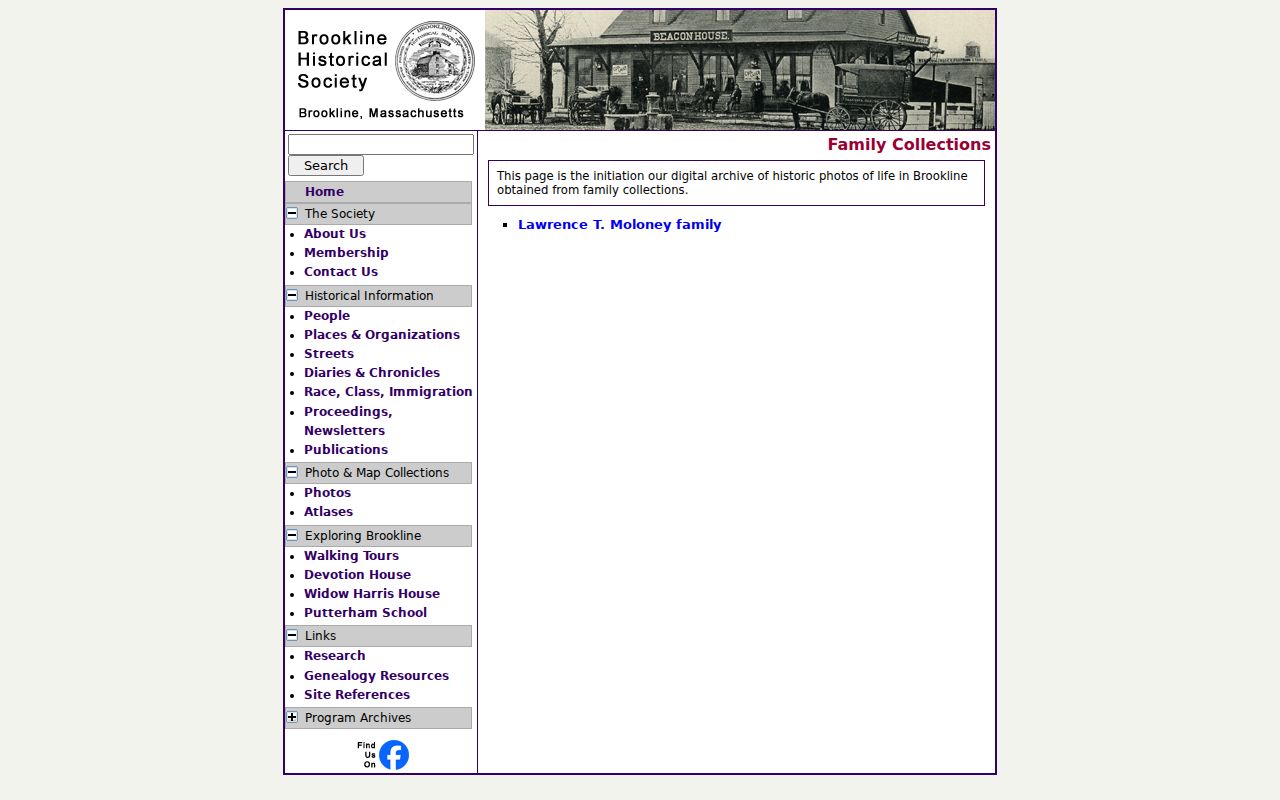
Those collection categories make it possible to test a bare directory entry against a family file, photograph caption, street material, or atlas rather than treating the printed line as a complete biography.
Brookline Street Lists and Blue Books
Use the Street List when the question is who appears at a particular address in a year. It is arranged by address and covers persons age 17 and older, with year of birth and occupation among the reported details. That scope differs from a full household count. Blue Book volumes answer a different question: their selected runs bring together leading residents, churches, clubs, and other civic or social associations, in alphabetical and street-address arrangements. Neither source should be treated as a full roster of everyone living in town.
The difference is useful in family research. A person may appear in a name-arranged volume but not at the address expected from a later Street List. Compare the publication year, the spelling, and the editorial purpose. The Brookline High School Murivian yearbooks and the Alumni Association directory can add school context, but the known yearbook gaps in 1998 and 2000-2002 remain gaps. Do not create a record where the collection has none.
Note: Preserve the source's own labels because a householder, boarder, business, or association entry is not interchangeable with an occupancy finding.
Reading a Brookline City Directory Entry
Begin with the surname and read the full name-arranged line before jumping to the street index. A local entry may offer a given name, address, and occasional occupation. The verified research did not produce a live scanned entry or a uniform abbreviation key, so symbols should be read from the exact volume in hand. Names can represent heads of household, spouses, boarders, servants, professionals, or businesses. The classification used by the volume matters as much as the name itself.
| Name | Surname and given name in the name-arranged listing; check spelling variants. |
|---|---|
| Address | Street and number when printed; compare it with the volume's street index. |
| Occupation | An occasional work description, not a complete account of a person's life. |
| Entry type | A person, household role, professional, boarder, business, or organization as classified by the source. |
| Street index | The reverse route from an address to entries at that number when the volume provides one. |
- Criss-cross directory
- An address- or street-ordered directory used to work from a house number back to listed names. Verify that the particular Brookline volume actually contains one.
- Householder index
- An index organized around the person treated as the household's primary entry, not a complete count of every resident.
- Abbreviation key
- The explanatory list printed in a volume, often near its front matter, that defines its own shortened labels and marks.
Brookline Room Directory Access
The Brookline Room is the strongest local reference stop because it combines directories with Street Lists, transfer directories, poll and property lists, obituary files, microfilm, maps, atlases, photographs, pamphlets, and yearbooks. Materials are non-circulating, and some require an appointment or contact with the archivist. The library's normal hours govern room access. For material not readily available online, that in-person route is part of the record trail, not a last resort.
The Massachusetts genealogy research guidance also points researchers to the State Archives for 1841-1935 vital-record research.
Archives research is in person and does not provide record images online. When a Brookline directory name points to a birth, marriage, or death event, custody and restrictions depend on the event type and date, so use the archives or local custodian route documented for that record.
A view of the Brookline Room local-history landing page shows the library route into these collections.
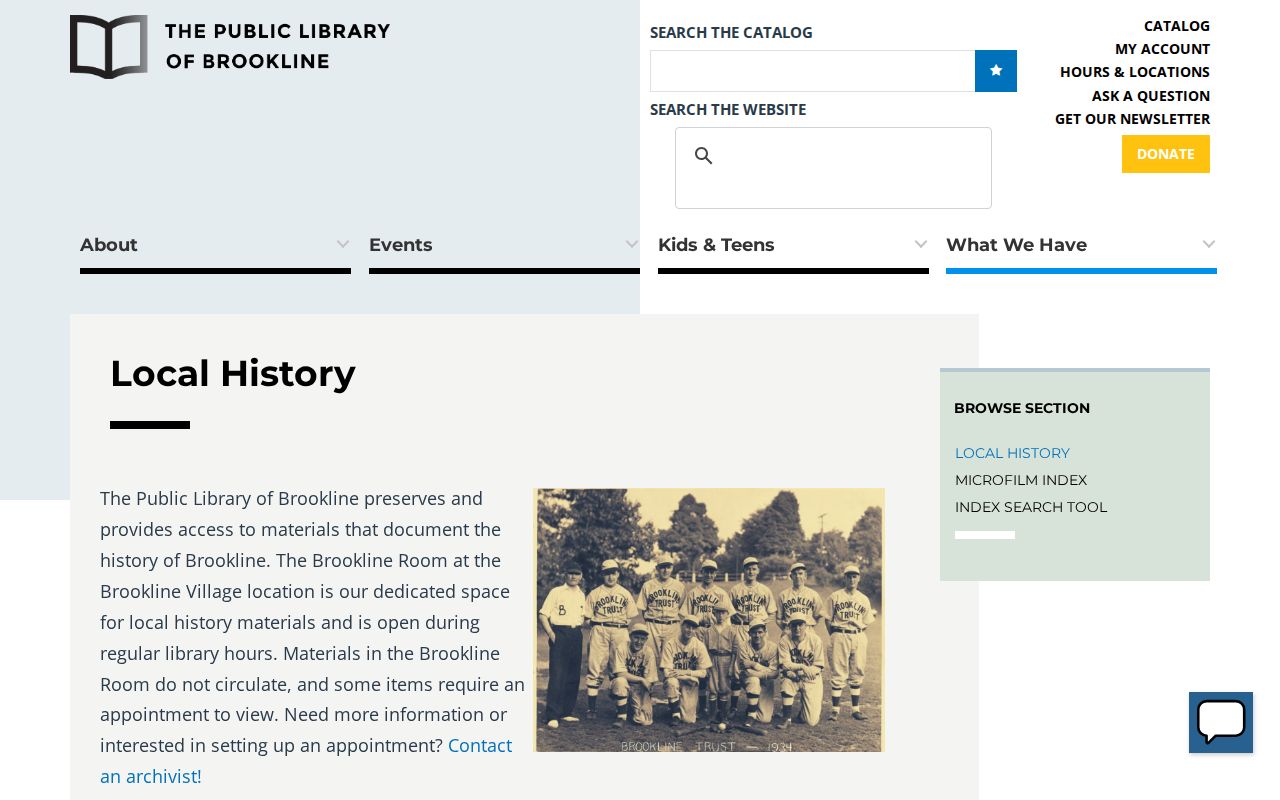
The local-history desk connects printed volumes to maps, microfilm, and staff guidance, which is especially helpful when an address spelling or directory year needs checking.
Brookline Directory Gaps in Newspapers
When a printed volume skips a year, turn to the local paper record without assuming a no-hit is a negative finding. The Brookline Chronicle is held on microfilm for 1874-1984, with an online index for 1874-1976. The Brookline Citizen covers 1935-1959 and 1984-1995 on microfilm. The Brookline TAB is available from 1980 forward on microfilm, with a NewsBank index from 2004 forward. The digitized archive scans several local titles, but its page counts vary by decade and earlier coverage is thinner than later runs.
The Brookline digitized newspaper archive supports searching, browsing, and downloading local paper scans. For names in the obituary file, the library's local-history indexes provide an index lead rather than the full article. The library reports that its index is incomplete, unsorted, and derived from card files, and it does not copy or send articles. Use the newspaper source or interlibrary loan for the article itself.
The local-history indexes are the source shown here for Brookline city directory and newspaper follow-up.
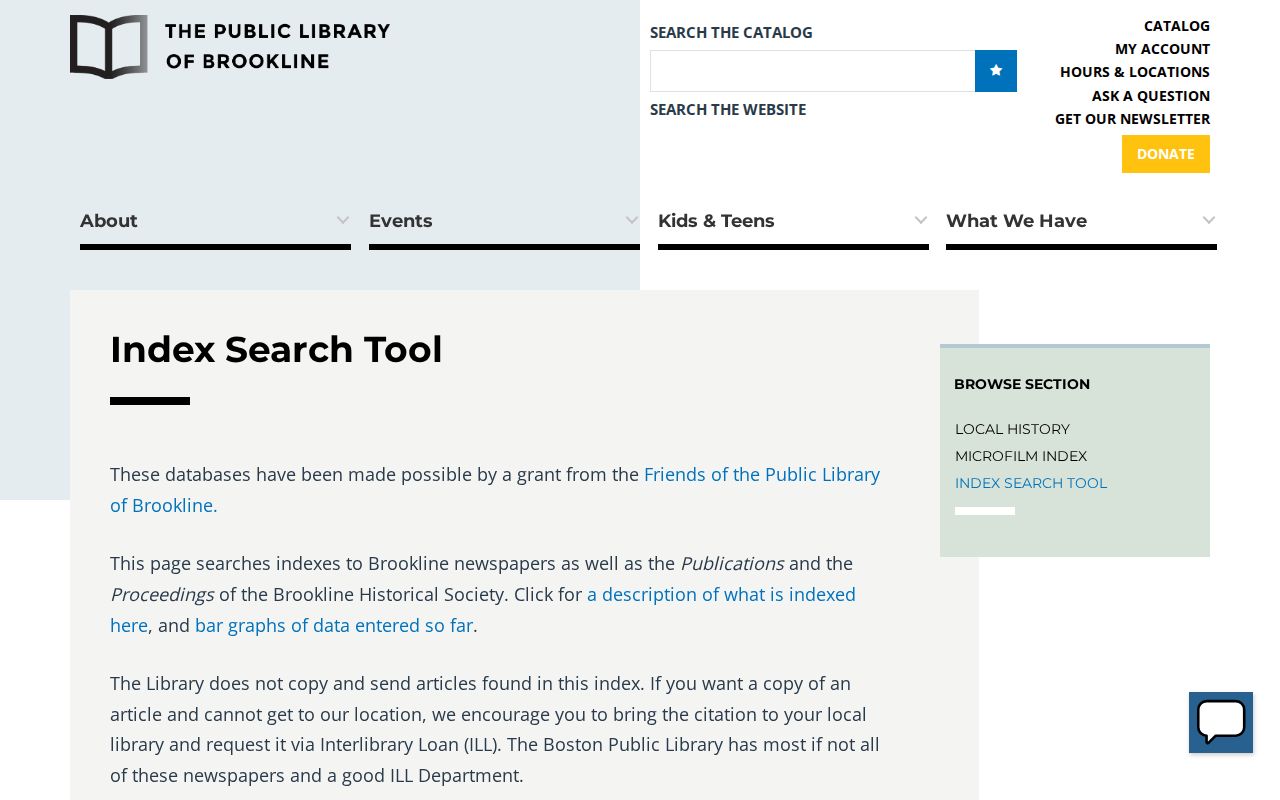
An indexed notice can fill a date gap or identify a spelling to try in a nearby directory volume, but the original newspaper still supplies the context.
Brookline Directory Maps and Streets
Old street names and numbers need their own research notes. Brookline's history includes Worcester Turnpike and Boylston, Mill Dam Road, Harvard Avenue, Brookline Avenue, and Longwood Avenue. Local-history material reports a renumbering on Brookline Avenue and Longwood Avenue after the 1890 Blue Book period to align addresses across the Boston town line. Treat that report as a lead, then test any conversion against the relevant directory volume, map, and deed. A current number may not point to the same parcel in an older book.
Maps offer a second check. The Library of Congress has digitized Brookline town-record volumes for 1838-1857, 1858-1871, and 1872-1884, with indexes and hundreds of images. The Historical Society's map collection is reported to reach as far back as 1636, and the Brookline Room map case holds atlases from the seventeenth century through the present. Pair a directory address with the closest dated map before concluding that a house, street, or boundary is unchanged.
Note: A Brookline map can establish dated physical context, but it does not by itself identify every person at an address.
Brookline City Directories for Families
A careful household trail keeps each source on its own terms. Start with the earliest available city-directory appearance of a surname, note its address and spelling, then move through the next available local volume. When a person moves, compare the Street List nearest that year and test the address against an atlas. If the question shifts to a current address or parcel, the modern record path is different and belongs with the Brookline Street Directory.
- Locate the surname in the earliest available local city directory and record the volume year exactly.
- Copy the printed address, entry type, and any occupation line, including spelling variants.
- Check the street index or address-arranged Street List for the same or nearby year.
- Use a map or atlas to test street names, renumbering, parcel context, and boundary changes.
- Use an obituary index or newspaper scan to pursue a date or event, then retrieve the original article.
People disappear from printed directories for many reasons: a move, death, omission, changed spelling, a collection gap, or the volume's own inclusion rule. Keep a simple date table with source, name, address spelling, entry type, and next lead. Modern identity questions require separate records and should be confirmed with the appropriate custodian.